



SHARE THIS POST:
Manufacturers are always trying to innovate quicker, raise quality, and simplify processes in the fast-changing Industry 4.0 terrain. The complexity of items and supply chains is only growing as we approach 2025, rendering old, siloed approaches to product creation obsolete. The solution now involves a better, more integrated flow of data rather than just better program. Step into the Digital Thread, the fundamental, connected data architecture providing a single, authoritative source of truth across the entire product lifecycle.

This is a basic business plan rather than just a technical upgrade. From original concepts to engineering, production, and servicing, the Digital Thread links every stage of a product’s path. It’s the solution to the data overload and fragmentation that prevents so many businesses from succeeding. In this blog, we’ll explore why modern engineering demands the Digital Thread and how it directly tackles the most pressing issues facing the business right now.
Why Digital Thread Matters in 2025?
Emerging trends in 2025 will render the digital thread even more vital. Advanced technologies—artificial intelligence/machine learning, Internet of Things, additive manufacturing—require thorough, contextual data. Aras experts point out that although AI and machine learning will be essential for product development, well-governed data streams are required. Resilience and agility depend on a consolidated digital thread, which is “no longer a nice-to-have but a must-have.” For example, AI can establish traceability across domains and satisfy new regulations like the Digital Product Passport, but only if the underlying digital thread is in place.
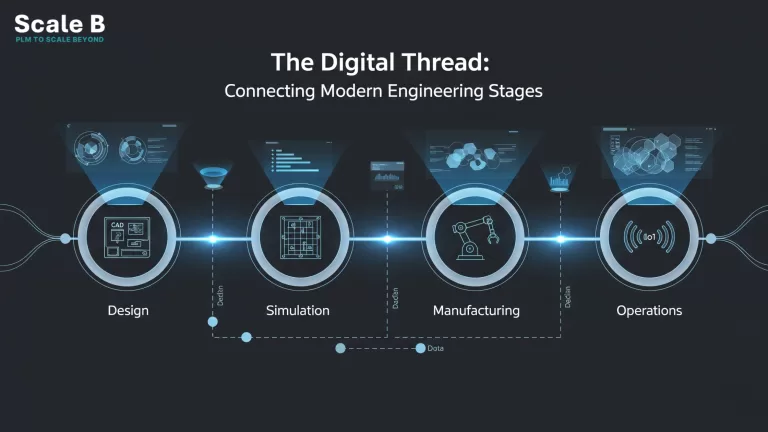
Supply chain disruptions and sustainability goals also underscore the need for end-to-end visibility. Companies have to incorporate sustainability information (carbon footprint, material sourcing, etc.) right into the product record by 2025. Analysts point out that a digital thread offers an authoritative source of truth across design, supply chain, and manufacturing. This traceability allows quick, data-driven decisions on ecofriendly designs and compliance. Having bidirectional traceability is especially important in controlled industries like aerospace or medical devices: digital thread enables teams to monitor any component or modification upstream (from in-service back to design) and downstream (from design through manufacturing), hence simplifying audits and lowering risk of defects or recalls.
The Key Issues and the Digital Thread Solution
The Digital Thread offers a straight cure for actual, expensive challenges engineering and manufacturing companies confront every day—it is not only an idea. Four essential areas that it tackles, let us analyze:
Change Management
Project failure’s main cause is bad change management. McKinsey & Company research found that 70% of change initiatives fall short of their objectives, sometimes owing to employee opposition and a lack of managerial support. Budget overruns, lost time, and lower morale follow from this failure.
The Solution: A Digital Thread offers a systematic, transparent framework for change management that guarantees all stakeholders immediate visibility into the effect of a change, hence promoting buy-in and lowering opposition by providing a single source of truth. This helps to implement changes quicker, more easily, and more successfully.
New ECN/ECO Revisions
Working with obsolete knowledge is a major cause of risk. As industry leaders point out, badly handled ECOs can cause risk, production delays, and put extra workload on teams. This causes expensive production mistakes and late release to market.
The Solution: The Digital Thread guarantees that everyone in the product lifecycle is working from the most recent Engineering Change Notice (ECN) and Engineering Change Order (ECO). Eliminating the risk of utilizing obsolete designs and greatly lowering redoing, it offers a clear, accessible record of all changes.
Cross-Functional Collaboration
The Problem: Silos between departments are a major barrier to efficiency. Research shows that “86% of employees and executives cite the lack of effective collaboration and communication as the main causes of workplace failures.” This lack of collaboration leads to misunderstandings, missed deadlines, and a decline in innovation.
The Solution: By building a common language and a shared data environment, the Digital Thread helps to eliminate these silos. It links engineering, manufacturing, and service teams with design to guarantee smooth communication across them. This creates a genuinely cooperative atmosphere where everybody is aligned and is aiming toward the same objectives.
Compliance and Traceability
The Problem: The financial consequences of non-compliance can be devastating. According to a report by Colligo, “The average cost of non-compliance was $14.82 million.” In industries like aerospace and medical devices, the inability to trace a component’s history can lead to massive recalls and legal liabilities.
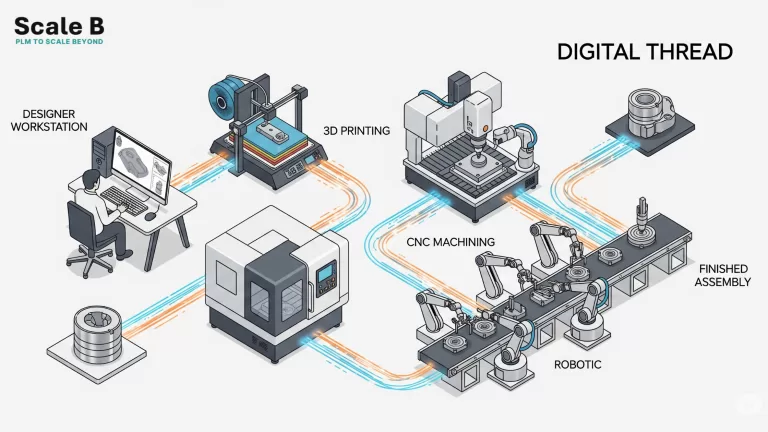
The Solution: The Digital Thread provides complete, end-to-end traceability. By creating an unalterable record of every component, process, and decision, it automates the creation of audit trails. This makes it simple to demonstrate compliance with industry standards and regulations, dramatically reducing risk.
ScaleB: A Digital Thread Platform
ScaleB, your reliable PLM partner, assists you in maximizing Aras Innovator’s potential to create a resilient and scalable Digital Thread. Connecting data, teams, and processes throughout the product life cycle, our team collaborates with you to help you to make quicker decisions, smooth change management, and better traceability. ScaleB, based on Aras’s strong lowcode platform, guarantees that your Digital Thread develops along with your company and blends seamlessly with your current systems.
Discover more about the possibilities of the platform and how ScaleB can help you along your implementation journey by exploring ScaleB Features.
Weaving Your Own Digital Future
Clearly, the Digital Thread is now a basic need for any company wanting to be competitive in 2025 and beyond rather than simply a “nice–to–have.” It is the foundation of a contemporary, flexible, and robust business.
To learn more about making the digital thread work for you, join our webinar “Digital Thread for Engineering Changes: Connect Teams, Data & Decisions” on August 6, 2025, 11am–12pm. Industry experts Dibyak Biswas and Satyajeet Kale will show how a well-implemented digital thread streamlines change management and drives better decisions. Don’t miss this opportunity to see how connected data can transform your product development and operations.
Conclusion:
The Digital Thread becomes the essential foundation for ongoing success in a world when product complexity, market demands, and regulatory pressure are continually growing. Companies may successfully overcome long-existing barriers, greatly speed time–to–market, improve product quality, and guarantee strong compliance across all activities by integrating every phase of a product’s life cycle with a dependable, realtime data stream. It gives companies the strategic edge that helps them go from a state of uncertainty to clarity, from reactive problem-solving to proactive innovation. Embracing the Digital Thread today means weaving a more resilient, effective, and competitive future for your products and, by extension, for your whole business.