



SHARE THIS POST:
Automotive suppliers must rethink engineering and change discipline because increasing OEM expectations, regulatory audits, and product complexity demand tighter control of engineering data. Relying on Excel, emails, and shared drives creates risk, delays, and audit exposure. Structured change management and a single source of truth are now essential for scalable supplier operations.
When engineering data flows through structured processes, teams gain greater visibility into product definitions, changes become easier to track, and operational alignment improves across departments. For suppliers supporting multiple programs and OEMs simultaneously, this level of control is becoming a fundamental requirement for maintaining efficiency, quality, and long-term competitiveness.
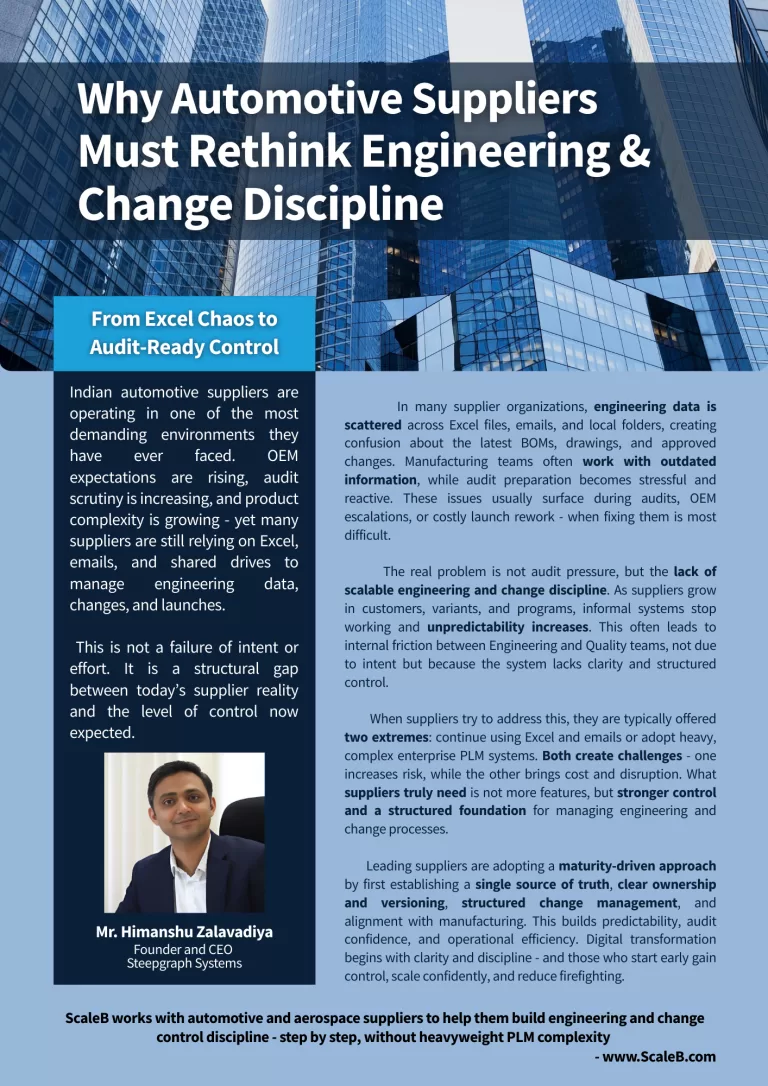
The Pressure on Automotive Suppliers Has Never Been Higher
The automotive and aerospace industries are entering one of the most demanding operational eras in decades.
OEM expectations are rising.
Regulatory scrutiny is increasing.
Product complexity is accelerating with electrification, software integration, and variant proliferation. Yet despite these changes, many suppliers are still managing engineering data using Excel spreadsheets, email chains, and scattered shared folders.
This creates a growing gap between what the industry expects and how many suppliers actually operate.
As Mr. Himanshu Zalavadiya, Founder and CEO of Steepgraph Systems, explains:
“Indian automotive suppliers are operating in one of the most demanding environments they have ever faced. OEM expectations are rising, audit scrutiny is increasing, and product complexity is growing – yet many suppliers are still relying on Excel, emails, and shared drives to manage engineering data, changes, and launches.”
The problem isn’t lack of effort or commitment from supplier teams. The problem is structural.
The Hidden Problem: Engineering Data Chaos
Inside many supplier organizations, engineering information lives in multiple disconnected places:
- Excel BOM files
- Email attachments
- Local desktop folders
- Shared network drives
- Informal change notes
- Versioned drawings without proper control
This fragmented environment creates one fundamental problem:
No one is completely certain which version of engineering data is correct.
Typical consequences include:
01
Outdated BOMs on the Shop Floor
Manufacturing teams sometimes work with older drawings or BOM revisions because updates were shared via email instead of a controlled system.
02
Unclear Engineering Ownership
When multiple engineers update spreadsheets or documents, accountability for changes becomes unclear.
03
Lost Change History
Critical questions arise during audits:
- Who approved this change?
- When was it implemented?
- Which part revisions were affected?
Without structured change control, answers become difficult to prove.
04
Audit Stress and Reactive Firefighting
Preparation for customer or certification audits becomes a last-minute scramble to assemble documentation. These issues rarely appear during normal operations.
They surface during the worst possible moments:
- OEM escalations
- Launch delays
- Quality issues
- Certification audits
When problems surface late, the cost of correction multiplies.
Why Excel-Based Engineering Management No Longer Scales

Excel spreadsheets and email coordination worked when suppliers had:
- Fewer programs
- Limited product variants
- Smaller teams
- Slower product cycles
But today’s reality is very different. Automotive suppliers now face:
- Multi-program operations
- Global OEM collaboration
- Complex supply chains
- Rapid engineering changes
- Strict traceability requirements
As companies grow, informal engineering systems collapse under complexity.
The result?
Increasing unpredictability across engineering and manufacturing.
The Real Issue: Lack of Engineering and Change Discipline
The root problem is not technology. It is the absence of structured engineering discipline.
Many organizations operate with:
- No single source of truth
- Inconsistent revision control
- Informal engineering change processes
- Weak alignment between engineering and manufacturing
- Limited traceability of decisions
This creates friction across teams.
Engineering vs Quality Conflict
Engineering believes changes are clear. Quality struggles to trace approvals.
Manufacturing believes they received the latest drawings. Engineering assumes they are using the correct version.
The friction is not caused by people. It is caused by systems that lack structure.
The Two Extreme Solutions Suppliers Are Offered
When suppliers try to solve these problems, they are often presented with two options:
Continue Using Excel and Emails
- No reliable change history
- High dependency on individuals
- Limited audit traceability
- Frequent data inconsistency
Over time, this approach becomes unsustainable.
Implement Heavy Enterprise PLM Systems
- High implementation cost
- Long deployment timelines
- Heavy customization requirements
- Major organizational disruption
- Steep learning curves for teams
For many mid-sized suppliers, this approach is too heavy for their operational reality.
What Suppliers Actually Need: Control, Not Complexity

The real requirement is not more features. It is structured engineering discipline. Leading suppliers are adopting a maturity-driven approach that focuses on foundational control first.
Key principles include:
- A Single Source of Truth
All engineering data – BOMs, drawings, revisions, and documentation – should exist in one controlled system. This eliminates confusion around which data is current.
- Clear Version and Revision Control
Every engineering artifact must have:
- Version tracking
- Revision history
- Change ownership
- Approval traceability
This ensures teams always work with the correct information.
- Structured Change Management
Engineering changes must follow defined workflows:
- Change request
- Impact assessment
- Approval process
- Implementation tracking
This improves accountability and reduces launch risk.
- Alignment Between Engineering and Manufacturing
Engineering changes must automatically flow to manufacturing teams. This ensures:
- Updated drawings reach the shop floor
- BOM changes align with production
- Launches proceed without rework
- Audit-Ready Traceability
Modern suppliers must demonstrate:
- Who approved each change
- When it was implemented
- Which versions were used in production
This level of traceability builds OEM confidence and audit readiness.
Digital Transformation Starts With Discipline
Many organizations view digital transformation as a technology initiative. In reality, successful transformation begins with clarity and discipline. Before advanced tools or automation can work, suppliers must first establish:
- Structured engineering workflows
- Clear change processes
- Controlled data management
Once this foundation exists, digital systems become powerful enablers. Without discipline, technology simply digitizes existing chaos.
The Suppliers That Will Lead the Next Decade
Suppliers that build engineering discipline today will gain major advantages:
Predictable Program Launches
Controlled change processes reduce launch surprises and delays.
Higher OEM Trust
Structured traceability builds confidence with customers.
Lower Operational Risk
Clear version control eliminates confusion across teams.
Faster Scaling
Disciplined systems allow suppliers to handle more programs and variants.
Reduced Firefighting
Engineering teams spend less time resolving data confusion and more time innovating.
The difference between reactive suppliers and scalable suppliers will increasingly come down to engineering control.
How ScaleB Helps Suppliers Build Engineering Discipline
ScaleB works with automotive and aerospace suppliers to establish engineering and change control discipline step by step. The goal is not to introduce heavy PLM complexity.
Instead, the focus is on building the essential foundation suppliers need:
- Engineering data control
- Structured change management
- Version tracking
- Manufacturing alignment
- Audit-ready traceability
This maturity-driven approach helps suppliers move from spreadsheet chaos to structured engineering control – without disrupting operations.
👉Learn more here.
FAQ: Engineering Change Management for Automotive Suppliers
Why is engineering change management critical for automotive suppliers?
Engineering change management ensures all product modifications are tracked, approved, and implemented correctly. Without structured processes, suppliers risk production errors, audit failures, and costly rework during launches.
Why are Excel spreadsheets risky for engineering control?
Excel lacks version control, approval workflows, and traceability. As organizations grow, spreadsheets create confusion about current BOMs, drawings, and change approvals.
What is a “single source of truth” in engineering data?
A single source of truth means all engineering information – drawings, BOMs, and revisions – is stored in one controlled system accessible to authorized teams. This eliminates version confusion.
Do suppliers always need large PLM systems?
Not necessarily. Many suppliers benefit from structured engineering discipline first, implemented through lightweight systems before considering large enterprise PLM deployments.
Conclusion
The automotive and aerospace industries are entering an era where engineering discipline is no longer optional.
As product complexity increases and OEM expectations rise, suppliers cannot rely on fragmented spreadsheets and informal change processes. The companies that thrive will be those that build:
- structured engineering control
- clear change management
- audit-ready traceability
Digital transformation does not begin with software. It begins with clarity, ownership, and disciplined engineering processes.
Suppliers that start this journey early will gain control, scale with confidence, and leave firefighting behind.