SHARE THIS POST:
For years, Environmental, Social, and Governance (ESG) initiatives were seen as the domain of large corporations. But times are changing. Customers, investors, and regulators are now asking smaller companies the same questions: What impact are you making on the environment? How do you treat your employees? Are you running your business responsibly?

Implementing ESG for small business may sound daunting, yet it has quickly become essential. Small and medium businesses (SMBs) that embrace ESG not only strengthen their reputations but also open doors to new opportunities, partnerships, and growth.
Why ESG for Small Business Is Gaining Importance
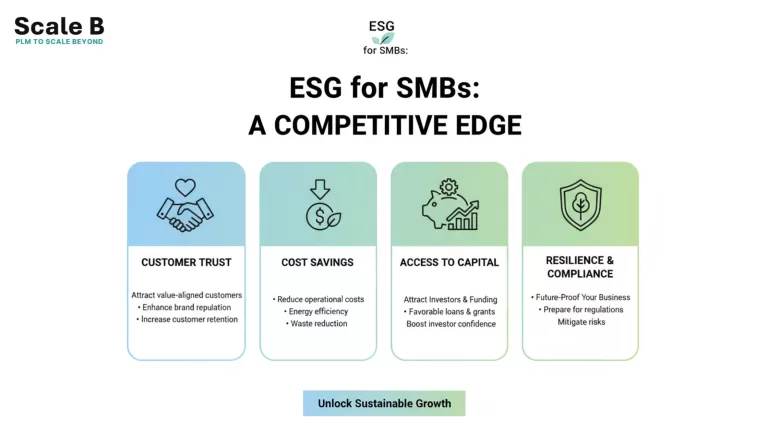
In today’s business landscape, ESG is not just a “nice-to-have.” It has become a competitive necessity. For SMBs, focusing on ESG can deliver tangible benefits:
- Stronger customer trust – Modern buyers prefer businesses aligned with their values.
- Cost savings – Simple measures like energy efficiency or waste reduction can cut expenses.
- Access to capital – Banks and investors increasingly factor ESG into lending and funding decisions.
- Resilience and compliance – Businesses that adopt sustainable practices are better prepared for regulatory changes.
By addressing ESG proactively, small businesses can turn challenges into advantages.
Common Challenges Small Businesses Face
Despite the benefits, ESG adoption in smaller organizations comes with hurdles:
- Resource limitations – Unlike large firms, SMBs may lack dedicated sustainability teams.
- Unclear frameworks – With so many ESG reporting standards, choosing the right one can be confusing.
- Difficulty measuring impact – Tracking emissions, employee diversity, or supply chain risks requires tools many SMBs don’t yet have.
- Short-term pressures – Daily operations sometimes overshadow long-term ESG planning.
Understanding these challenges is the first step toward overcoming them.
Practical Steps to Get Started with ESG
Even with limited resources, SMBs can begin their ESG journey with a structured approach. Here’s a simple framework:
- Identify priorities – Focus on ESG issues most relevant to your business, such as energy use, employee well-being, or supply chain transparency.
- Set clear goals – Define measurable, achievable targets (e.g., reduce energy use by 10% in one year).
- Collect data – Start tracking key metrics like electricity bills, water usage, or staff engagement surveys.
- Engage employees – Encourage staff to participate in sustainability efforts and provide training where needed.
- Communicate progress – Share updates with customers, suppliers, and investors to build credibility.
- Improve continuously – ESG is not a one-time effort; review your progress regularly and adjust.
By taking small but consistent steps, businesses can create a lasting impact without overextending resources.
Real-World Examples of ESG in Small Businesses
- SME Case Studies: Successful ESG Reporting — examples of smaller companies adopting ESG reporting and the benefits they’ve achieved
- Employee Engagement and a Company’s Sustainability Values: A Case Study of a FinTech SME — shows how ESG practices affect employee engagement in an SME context
- The Container Store: ESG Case Study — governance, employee education, ESG strategy (though larger company, useful as reference)
- Case studies | McKinsey: Sustainability — larger-scale examples of ESG in operations and emissions, good for framework illustration
These examples show that ESG is not just about compliance—it’s about making smarter business choices that benefit people, profit, and the planet.
The Role of Digital Tools in ESG for Small Business
One of the biggest hurdles SMBs face is the lack of systems to track, manage, and report ESG efforts. Relying on spreadsheets and manual processes often leads to inefficiencies and missed opportunities.
This is where digital platforms designed for SMBs play a crucial role. By centralizing ESG data, providing ready-made templates, and offering reporting capabilities, these solutions allow small businesses to focus on impact rather than administration.
Conclusion: A Smarter Path Forward
Embracing ESG for small business is no longer optional—it’s a pathway to resilience, competitiveness, and long-term success. While challenges exist, a clear strategy, commitment to continuous improvement, and the right digital support can make ESG both achievable and rewarding.
For SMBs ready to move from intention to action, digital platforms like ScaleB can help simplify the journey. Built on robust technology, ScaleB offers affordable, scalable tools that enable SMBs to track ESG performance, collaborate with suppliers, and stay ahead of compliance requirements.
📘 Want to take the next step? Download our ESG Checklist and get the ScaleB Brochure here to explore how small businesses like yours can build a smarter, sustainable future.